
5 Tax-Saving Checks Every Business Owner Should Do Before Tax Season

Tax season has a nasty habit of arriving faster than expected.
One minute you are focused on running the business, managing staff, keeping customers happy, and trying to stay ahead of rising costs. The next minute, SARS is knocking, deadlines are looming, and you are suddenly expected to know exactly what can be claimed, what cannot, what is missing, and how much tax should have been planned for months ago.
That is why smart tax planning should start before tax season, not during the panic.
The good news is that there are a few practical checks every business owner can do now to reduce stress, improve compliance, and make sure they are not paying more tax than necessary.
Here are five tax-saving checks worth reviewing before tax season starts.
These themes are drawn from the kinds of tax-saving issues covered in the uploaded strategy guides, including business deductions, VAT inputs, bad debts, asset write-offs, and provisional tax planning.
1. Claim the Real Cost of Doing Business
Many business owners still underclaim legitimate business expenses.
That means they end up paying tax on profits that are higher than they should be — not because the business made more money, but because expenses were not captured, not recorded properly, or simply overlooked.
Typical deductible business expenses may include:
- accounting fees
- software subscriptions
- business insurance
- bank charges
- internet and phone costs
- office expenses
- repairs and maintenance
- professional services
- marketing and advertising
- other genuine costs incurred in producing income
The key point is simple: if an expense is a real business cost, it should be reviewed properly and recorded correctly.
Of course, this is not an excuse to throw your weekend braai into the books and call it “strategic meat planning.” Personal expenses are still personal expenses. But many business owners go too far the other way and fail to claim costs they are fully entitled to deduct.
A proper review of your expenses can make a meaningful difference to your taxable profit.

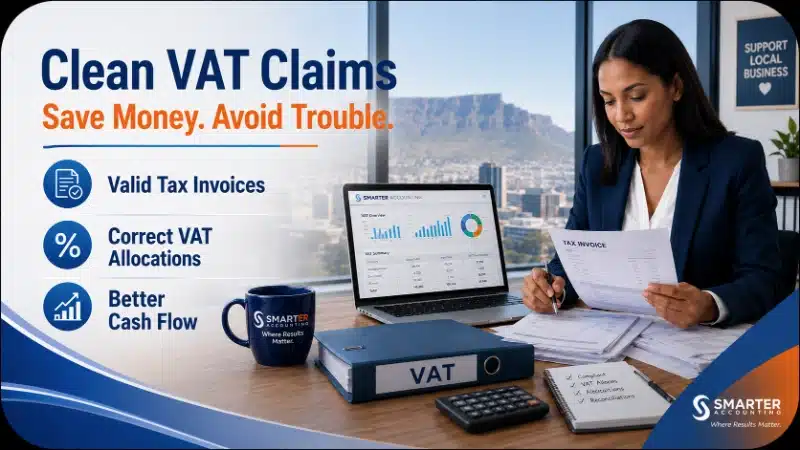
2. Make Sure VAT Input Claims Are Complete and Clean
If your business is VAT-registered, input VAT can be one of the easiest places to either save money properly — or create unnecessary trouble.
Many businesses miss valid input VAT claims because their records are incomplete, invoices are missing, or expenses have not been posted correctly. On the other hand, some businesses claim VAT where they should not, which is a fast way to attract unwanted SARS attention.
Good VAT management means:
- keeping proper tax invoices
- allocating expenses correctly
- reviewing whether the expense was genuinely for business use
- making sure mixed-use items are treated properly
- avoiding careless or unsupported claims
VAT is not just an admin exercise. It affects cash flow directly.
If valid input claims are missed, you may be handing SARS money that should have stayed in your business. If incorrect claims are submitted, you may create future headaches that cost far more to fix.
A clean VAT review before tax season is one of the smartest housekeeping jobs a business can do.
3. Write Off Bad Debts and Obsolete Stock
Not every sale becomes cash.
Not every item of stock remains valuable forever.
That is why bad debts and obsolete stock should be reviewed properly before tax season. If customers are not going to pay, or stock is damaged, expired, out of date, or no longer saleable, the business should not carry those values blindly as if everything is still fine.
This is one of the more overlooked areas in small business tax planning.
If you continue showing income that will never be received, or stock that no longer has real value, you may distort both your profit and your tax position.
This is where proper accounting matters:
- old debtors should be reviewed
- doubtful or irrecoverable debts should be assessed
- slow-moving, damaged, or expired stock should be identified
- supporting records should be kept
- the tax treatment should be considered carefully
In short, dead debt should not keep haunting the business like a bad movie sequel.
A proper review here can improve both the accuracy of your financial statements and the fairness of your tax bill.

4. Claim Depreciation and Asset Allowances Correctly
Business assets such as computers, laptops, office equipment, tools, machinery, and other equipment may qualify for deductions — but not always in the same way.
One of the common mistakes business owners make is assuming that every asset purchase is treated the same. It is not.
Some assets may be written off over time. Some may qualify for accelerated treatment depending on the business and the type of asset. Timing also matters, especially around year-end or where equipment has recently been purchased and brought into use.
This means businesses should review:
- which assets were acquired during the year
- whether they are being used in the business
- whether they have been classified correctly
- whether the correct write-off method is being applied
- whether any tax allowance opportunities are being missed
Asset planning is not just about reducing tax. It is also about keeping proper records and making sure the business gets the benefit of what it has already invested in.
If you are buying equipment, upgrading systems, or improving the way the business operates, it is worth checking whether your tax treatment is aligned with that investment.

5. Plan Provisional Tax Before It Becomes a Cash-Flow Shock
This one is not a deduction, but it is one of the most important tax-saving and tax-planning checks of all.
Too many business owners only think about provisional tax when payment deadlines arrive. By then, the money has usually already been spent somewhere else — on stock, wages, overheads, or life in general.
That is when SARS arrives with its usual warm hug and cold invoice.
Provisional tax planning is essential because it helps business owners:
- estimate likely tax exposure in advance
- avoid large unexpected payments
- reduce the risk of penalties and interest
- set money aside gradually
- manage cash flow more sensibly throughout the year
If profits have grown, tax is likely to grow too. If income has fluctuated, the estimates may need attention. If no one has reviewed the numbers properly, the business owner is often the last person to know how exposed they really are.
A proper provisional tax review is not about scaring people. It is about avoiding nasty surprises and making better financial decisions ahead of time.
Good tax planning is always easier than last-minute tax scrambling.

Final Thought
Tax season should not be the moment when a business owner first discovers that records are incomplete, expenses were missed, VAT has not been reviewed, debtors are overstated, or provisional tax has not been planned for.
By then, your options are more limited, the pressure is higher, and the chance of missing something important is far greater.
The smarter approach is to review now.
A few practical checks before tax season can help you:
- claim what you should be claiming
- improve your records
- reduce unnecessary tax
- strengthen your cash flow planning
- and go into tax season better prepared
This is not about aggressive tax tricks or fancy gimmicks.
It is about getting the basics right, properly and on time.
And that can make a very real difference to your business.
Free Tax-Saving Review
Before tax season starts, let us review whether your business is claiming what it should — and whether your records are ready.
If you are unsure whether your expenses, VAT, bad debts, asset write-offs, or provisional tax planning are being handled properly, I’m offering a free consultation to help you identify the main areas that may need attention.
We can discuss:
- whether you may be missing valid deductions
- whether your VAT claims and records need review
- whether bad debts or old stock should be looked at
- whether your asset write-offs are being handled correctly
- whether your provisional tax planning is on track
No pressure.
No jargon overload.
Just practical advice to help you plan better and avoid unnecessary tax stress.
Need Help Getting Ready for Tax Season?
If you would like to review your tax position and see whether your business is claiming correctly and planning properly, get in touch.
David Hartley
Smarter Accounting
Where Results Matter
📞 WhatsApp / Mobile: 082 061 2300
📧 Email: david@smarteraccounting.co.za
🌐 Website: www.smarteraccounting.co.za
Book your free consultation and let’s make sure your business is tax-season ready.