
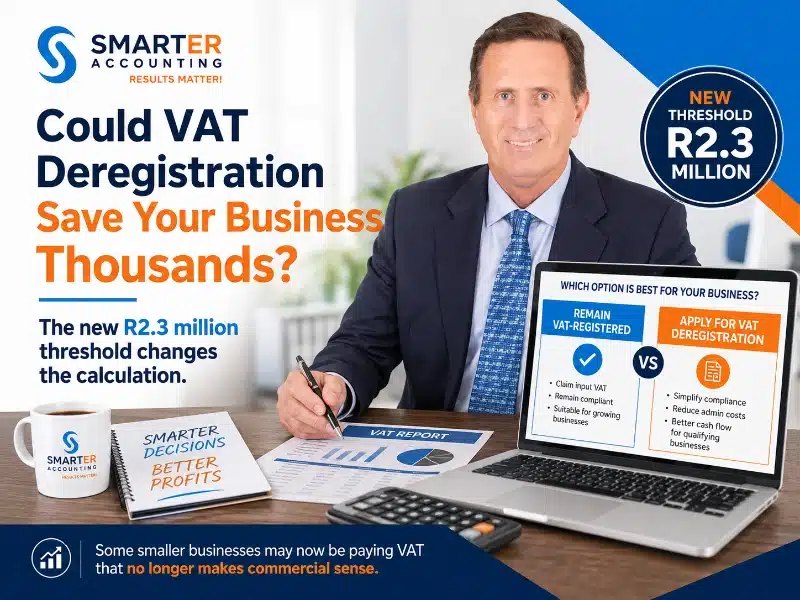
Could VAT Deregistration Save Your Business Thousands Every Month?
The new R2.3 million VAT threshold could materially improve margins for the right small business
Imagine improving your business margin without finding another customer, increasing your sales or working longer hours.
That is exactly what we identified during a recent VAT review.
The business was earning approximately R150,000 per month, or around R1.8 million per year. Most of its customers were private or community-based clients who were not registered for VAT and could not claim back the VAT charged to them.
After reviewing the business’s selling prices, supplier costs and input VAT, we estimated that VAT deregistration could improve its financial position by approximately:
- R12,000 per month
- R144,000 per year
- approximately 8% of turnover
The business did not need to charge its customers more.
It could simply retain more of its existing selling price instead of paying part of that amount across as VAT.
That result will not apply to every business. However, it shows why businesses currently earning between the old R1 million threshold and the new R2.3 million threshold should review whether VAT registration still makes financial sense.
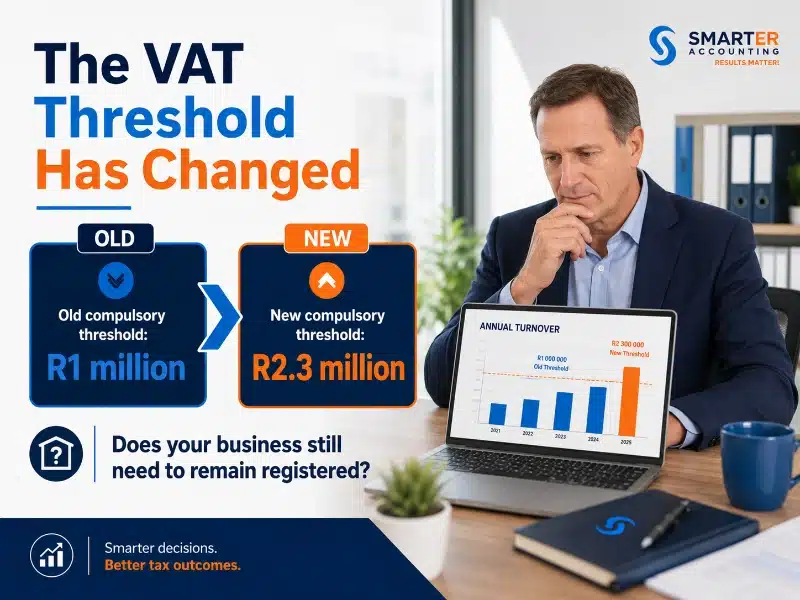
From 1 April 2026, the compulsory VAT-registration threshold increased from R1 million to R2.3 million in taxable supplies over a consecutive 12-month period. SARS specifically identifies reduced paperwork, cheaper compliance and more room for smaller businesses to grow as benefits of the higher threshold. (South African Revenue Service)
1. You May No Longer Be Compelled to Remain VAT-Registered
Thousands of South African businesses registered for VAT because their taxable turnover exceeded the previous compulsory threshold of R1 million.
That was not necessarily a choice. It was a legal requirement.
The rules have now changed.
What the change means
From 1 April 2026, compulsory VAT registration generally applies once taxable supplies exceed, or are expected to exceed, R2.3 million in the applicable consecutive 12-month period. (South African Revenue Service)
A business with taxable turnover below R2.3 million may therefore have an opportunity to apply for cancellation of its VAT registration.
But the registration does not disappear automatically.
The business must first review:
- taxable turnover for the preceding 12 months;
- expected turnover for the following 12 months;
- signed contracts and confirmed future work;
- seasonal fluctuations;
- whether turnover is growing rapidly;
- whether the business may soon exceed R2.3 million again.
A stable business earning R1.5 million per year may be a strong candidate for review.
A business earning R2.2 million and growing quickly may be better off remaining registered rather than deregistering and then applying to register again shortly afterwards.
The new threshold gives businesses a choice.
It does not remove the need to make a careful decision.
2. Your Customer Profile Could Make VAT Expensive
VAT registration works differently depending on who buys from you.
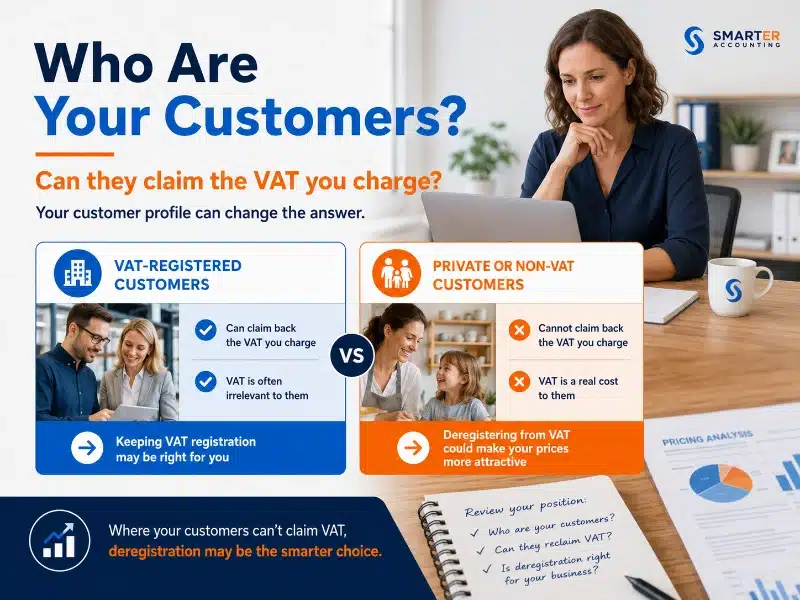
When customers are registered VAT vendors, they may generally claim qualifying input VAT from a valid tax invoice.
Private individuals and non-VAT organisations cannot.
To them, VAT is simply part of the total price they must pay.
Why this matters
Suppose a service business charges a market-related amount of R1,150.
While VAT-registered, a portion of that selling price represents output VAT that must be declared to SARS, after deducting qualifying input VAT.
If the business deregisters and can continue charging the same market-related amount, it may retain more of that price as revenue.
This can be particularly relevant for businesses serving:
- private individuals;
- residential customers;
- parents and families;
- community organisations;
- clubs and associations;
- small businesses that are not VAT vendors;
- personal-service clients;
- certain training, tutoring and consulting clients.
These customers cannot recover the VAT.
They normally compare suppliers based on the final amount they must pay.
A VAT-registered service provider may therefore be giving part of its established selling price to SARS without receiving a corresponding commercial advantage from its customer base.
However, the calculation must also account for the input VAT the business will lose after deregistration.
The question is not simply whether customers cannot claim VAT.
The question is whether the VAT currently paid on sales is greater than the value of the input VAT, pricing advantages and other benefits the business would lose.
3. A Real Review Produced an Estimated R12,000 Monthly Improvement
This is not merely a theoretical tax exercise.
We recently applied the calculation to an actual small business.
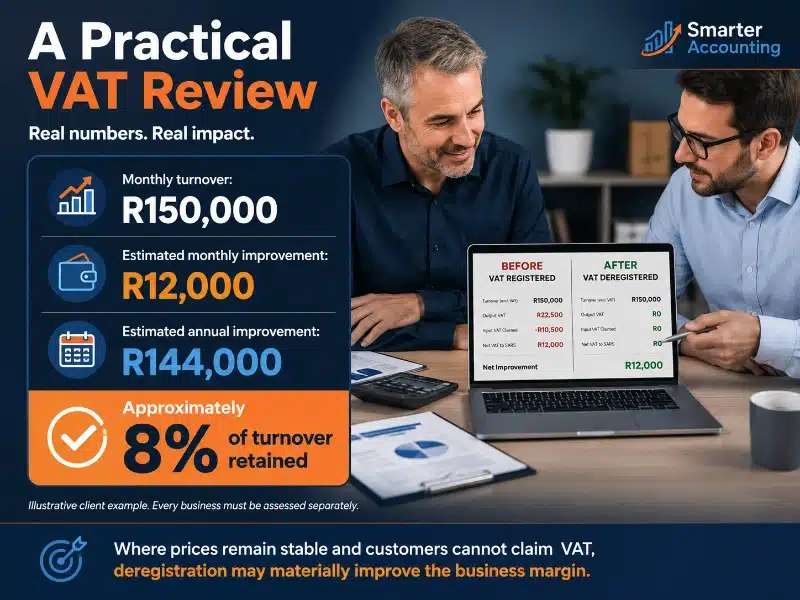
Its turnover was approximately R150,000 per month, or about R1.8 million annually.
Its customers were mainly not registered for VAT, and its established selling prices were expected to remain unchanged.
How the calculation worked
The business did have cost-of-sales items purchased from a VAT-registered supplier.
After deregistration, the VAT included in those supplier costs would no longer be recoverable as input VAT.
We therefore compared:
- the VAT included in current sales;
- output VAT declared to SARS;
- input VAT claimed from suppliers;
- the selling prices expected after deregistration;
- the additional VAT-inclusive supplier costs;
- the net effect on the business margin.
After allowing for the lost input VAT, the estimated improvement was approximately:
R12,000 per month
That equates to:
R144,000 per year
The benefit represented approximately 8% of turnover.
The result should not be described as receiving an automatic extra 15% profit.
That would ignore the input VAT the business would no longer recover from suppliers.
The proper result is the net commercial improvement after taking both sides of the VAT calculation into account.
For this client, the benefit was substantial.
For another business, it may be smaller.
For some businesses, remaining registered will still produce the better result.
That is precisely why the financial calculation must be completed before the SARS application.
4. The Saving Is Not Only About VAT
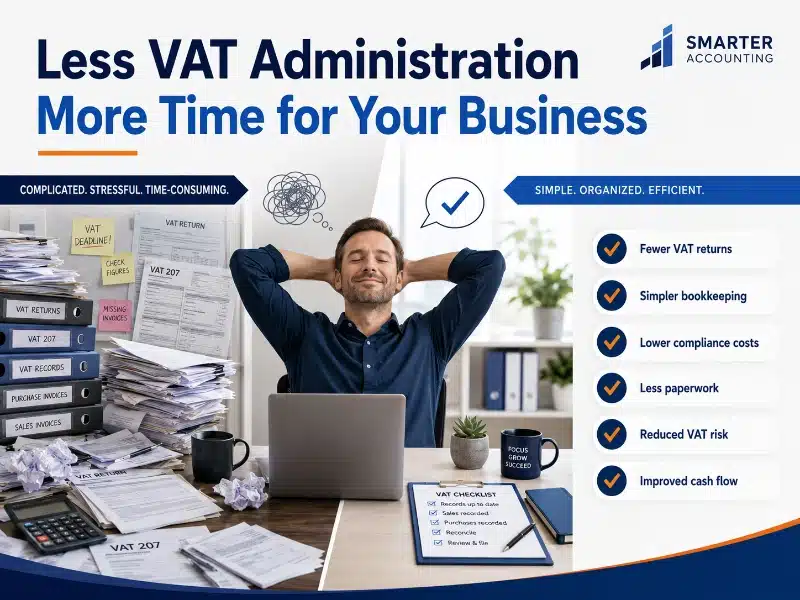
A successful deregistration may improve the margin, but the practical benefits can extend much further.
VAT compliance consumes time, professional fees and management attention.
Every two-month VAT cycle can involve collecting invoices, checking tax invoices, reviewing allocations, reconciling VAT control accounts, preparing the VAT201 and dealing with queries or differences.
The potential practical advantages
Where VAT deregistration is commercially appropriate, the business may benefit from:
Saving administration time
The business will no longer need to prepare routine VAT201 returns after the final VAT period has been completed.
That can reduce time spent:
- separating VAT and non-VAT expenses;
- checking tax invoices;
- following up on missing documents;
- reconciling VAT control accounts;
- reviewing output and input VAT;
- preparing supporting schedules.
Reducing accounting and compliance costs
VAT returns require regular bookkeeping, reconciliations and professional review.
Removing an unnecessary VAT obligation may lower the recurring cost of maintaining the business’s tax compliance.
Simplifying invoicing and pricing
Invoices no longer need to calculate and disclose VAT once the cancellation has become effective and the business is no longer a vendor.
Pricing may become easier to explain to private customers who are interested only in the final amount.
Reducing VAT errors and compliance risk
Incorrect input claims, missing tax invoices, late submissions and reconciliation differences can result in SARS queries, penalties and interest.
A non-VAT business no longer carries the same ongoing VAT-submission risk.
Improving cash flow
The business no longer collects output VAT on future taxable sales after the effective deregistration date.
Where prices remain stable, a larger portion of the selling price may remain available to cover costs and generate profit.
Freeing the owner to focus on the business
Time spent gathering VAT documents and resolving VAT differences is time not spent on customers, operations and growth.
Less paperwork is not glamorous, but neither is spending Sunday evening hunting for an invoice from six weeks ago.
SARS itself identifies less paperwork, cheaper compliance and more room for growth as intended benefits of the higher threshold. (South African Revenue Service)
5. Deregistration Can Also Be the Wrong Decision
A business should not deregister merely because its turnover is below R2.3 million.
The wrong VAT decision can damage pricing, contracts, cash flow and future growth.
Some businesses receive far greater value from remaining VAT-registered.

When remaining registered may be better
The business may benefit from remaining VAT-registered where:
- customers are VAT vendors and expect tax invoices;
- corporate customers require suppliers to be VAT-registered;
- tenders or contracts require VAT registration;
- substantial stock or materials are purchased;
- significant input VAT is recovered;
- equipment or capital purchases are planned;
- turnover is likely to exceed R2.3 million soon;
- deregistration would make the business appear less commercially suitable to key clients.
A retailer, wholesaler, manufacturer or construction business may recover substantial VAT on stock, materials and equipment.
Its circumstances can be very different from those of a consultant or service business with relatively low VAT-bearing costs.
What must be reviewed before applying
A proper review should consider:
Customers
- Are they private customers or VAT vendors?
- Can they claim VAT?
- Would they expect prices to fall?
- Would deregistration affect contracts or tenders?
Suppliers and expenses
- How much input VAT is currently claimed?
- Does the business buy significant stock or materials?
- Are large purchases planned?
- How much will unrecoverable VAT increase costs?
Turnover and growth
- Is turnover expected to remain below R2.3 million?
- Are new contracts likely?
- Is the business growing?
- Would deregistration only be temporary?
Assets and stock
- What assets and stock remain on hand?
- Was input VAT previously claimed?
- Could the final VAT period create an exit liability?
Administration
- What does VAT compliance cost?
- How much owner and staff time does it consume?
- Are VAT reconciliations regularly delayed or difficult?
- Is the compliance burden greater than the financial benefit?
6. You Must Continue Charging VAT Until SARS Approves the Cancellation
A business cannot simply stop charging VAT because its turnover has fallen below the threshold.
It must apply to SARS for cancellation.
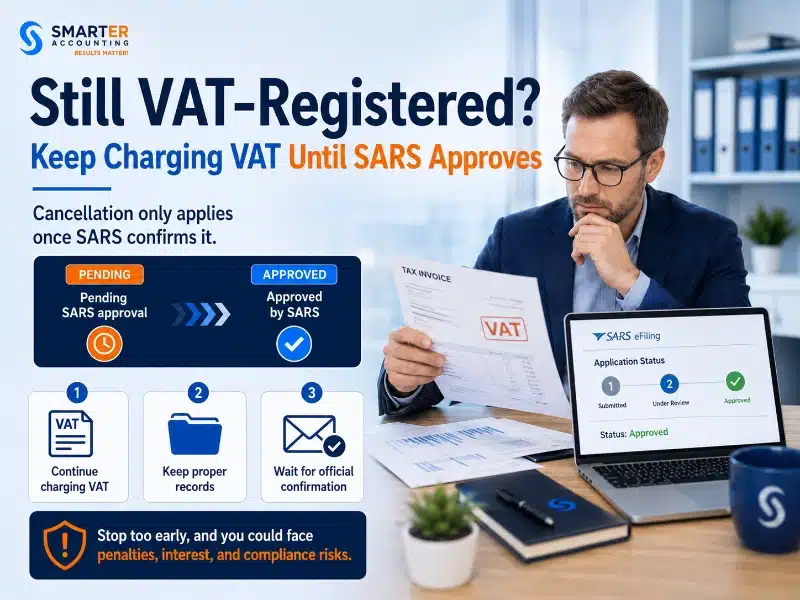
SARS may cancel a VAT registration where taxable supplies are expected to remain below the R2.3 million compulsory threshold in a consecutive 12-month period. The vendor must apply using the prescribed cancellation process, which includes the VAT123e form. (South African Revenue Service)
Until SARS confirms the effective cancellation date, the business must continue complying as a registered VAT vendor.
That includes continuing to:
- charge VAT;
- issue the correct tax invoices;
- submit VAT201 returns;
- declare output VAT;
- claim qualifying input VAT;
- pay any VAT owing.
Stopping prematurely can create incorrect invoices, unpaid VAT, penalties and interest.
The main steps in a VAT deregistration project
- Review taxable turnover for the relevant 12-month periods.
- Forecast turnover for the following 12 months.
- Compare the financial outcome before and after deregistration.
- Review the VAT status of customers and suppliers.
- Identify assets and stock still held.
- Calculate the possible VAT consequences on those assets.
- Confirm that VAT returns and payments are up to date.
- Complete the VAT123e application.
- Prepare the motivation and supporting schedules.
- Submit the application to SARS.
- Respond to any SARS queries.
- Continue normal VAT compliance while awaiting confirmation.
- Confirm the effective cancellation date.
- Prepare and submit the final VAT return.
A VAT liability may arise on certain assets or stock retained when registration is cancelled, particularly where input VAT was previously claimed.
That is why VAT deregistration should be treated as a proper tax and financial-review project—not as a form that gets signed between coffee and lunch.
Final Thought
The increase in the VAT-registration threshold creates a genuine opportunity for smaller South African businesses.
Businesses that registered because they exceeded the previous R1 million threshold may no longer be compelled to remain registered.
For the right service business selling mainly to private or non-VAT customers, VAT deregistration may:
- improve profit margins;
- improve cash flow;
- reduce VAT administration;
- lower bookkeeping and compliance costs;
- simplify invoicing;
- reduce VAT-submission risk;
- free up valuable management time.
But turnover alone does not provide the answer.
The decision must consider customers, suppliers, expenses, assets, stock, contracts and future growth.
The correct question is not simply:
“Can my business deregister?”
The more valuable question is:
“Would VAT deregistration leave my business financially and commercially better off?”
That calculation could be worth thousands of rand every month.
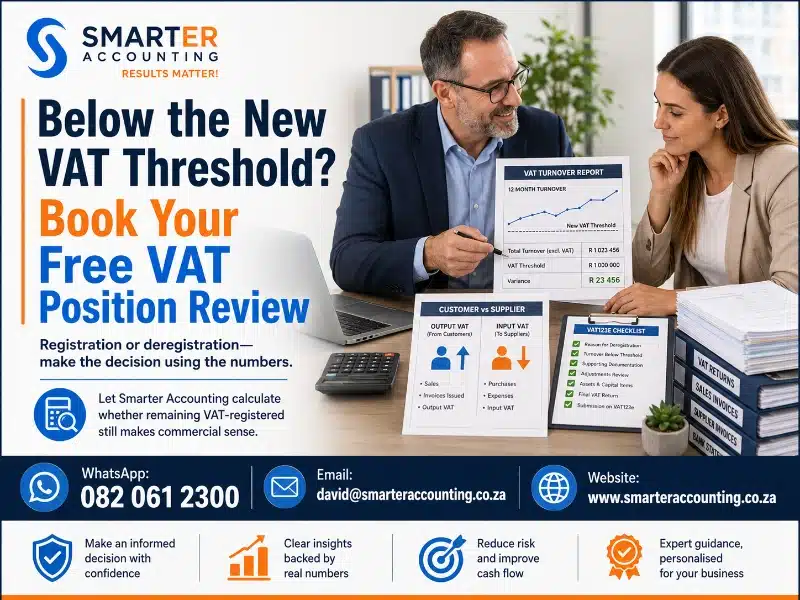
Free VAT Position Review
If your annual taxable turnover is below R2.3 million, your business may qualify to apply for VAT deregistration.
Qualification is only the first step.
Smarter Accounting can help you establish:
- whether the business may qualify;
- whether selling prices could remain stable;
- how much input VAT would be lost;
- the likely monthly margin improvement;
- whether customers or contracts require VAT registration;
- whether stock and assets may create a final VAT liability;
- whether remaining registered is still the better option;
- what documents and SARS applications will be required.
We base the review on your actual turnover, expenses and customer profile.
No assumptions.
No blanket promises.
Just a practical financial calculation showing which option makes better business sense.
Could VAT Deregistration Improve Your Business Margin?
If your turnover is below R2.3 million and your customers are mainly private individuals or non-VAT businesses, your VAT position deserves a proper review.
David Hartley
Smarter Accounting
Where Results Matter
WhatsApp / Mobile: 082 061 2300
Email: david@smarteraccounting.co.za
Website: www.smarteraccounting.co.za
Book your free initial VAT position review and let us calculate whether VAT registration is helping your business—or quietly costing it money.