
Tax Season 2026 Has Started: What Business Owners and Taxpayers Should Do Now
Tax season has officially started.
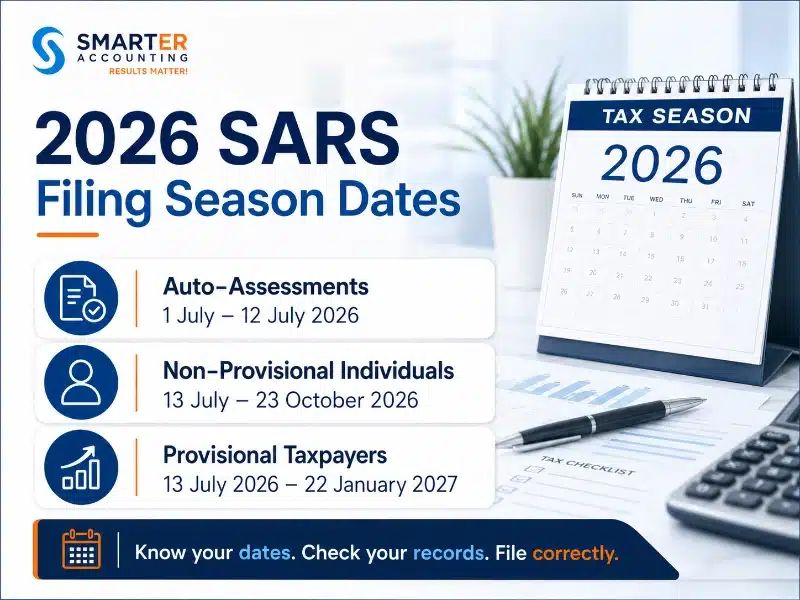
From 1 July to 12 July 2026, SARS is rolling out auto-assessments.
After that, the broader filing season opens for individual taxpayers and provisional taxpayers from 13 July 2026.
This is where many taxpayers make the same mistake every year:
- They wait for SARS to send something.
- They wait until documents are missing.
- They wait until the deadline gets close.
- They wait until the refund does not arrive.
- They wait until there is a query, penalty, or problem.
- That is the wrong approach.
Tax season is much easier when you prepare early, check properly and do not accept information blindly.
This week’s message is simple:
Do not leave tax season until the last minute. Check your position now.
In this article, we look at six practical areas:
- Know your SARS filing dates.
- Do not accept an auto-assessment without checking it.
- Gather your supporting documents early.
- Business owners must check their bookkeeping and records.
- Review deductions, VAT, payroll and provisional tax.
- Get help before the pressure starts.
The goal is not to panic.
The goal is to be ready.

1. Know the 2026 SARS Filing Dates
Before you prepare anything, know which tax window applies to you.
The 2026 filing season is phased. That means tax season does not open for everyone in the same way on the same day.
Auto-assessments come first. Then the broader filing season opens for individual taxpayers and provisional taxpayers.
If you are selected for auto-assessment, SARS may send you a notification by SMS or email.
If you agree with the auto-assessment and everything is correct, you may not need to submit anything further.
But that does not mean you should ignore it.
You still need to check it.
If you are not auto-assessed, or if the auto-assessment is wrong or incomplete, you may need to submit or correct your return through eFiling or the SARS MobiApp.
For business owners and provisional taxpayers, the filing window runs longer, but that does not mean you should relax until January. Longer deadlines often create false comfort. The work still needs to be done properly.
2. Do Not Accept an Auto-Assessment Without Checking
Auto-assessments can be useful.
They can save time. They can reduce admin. They can make the filing process easier where the information is simple and complete.
But they are not magic.
SARS uses information from third parties such as employers, banks, medical schemes, retirement funds and investment institutions. That information may be useful, but it may not tell the full story.
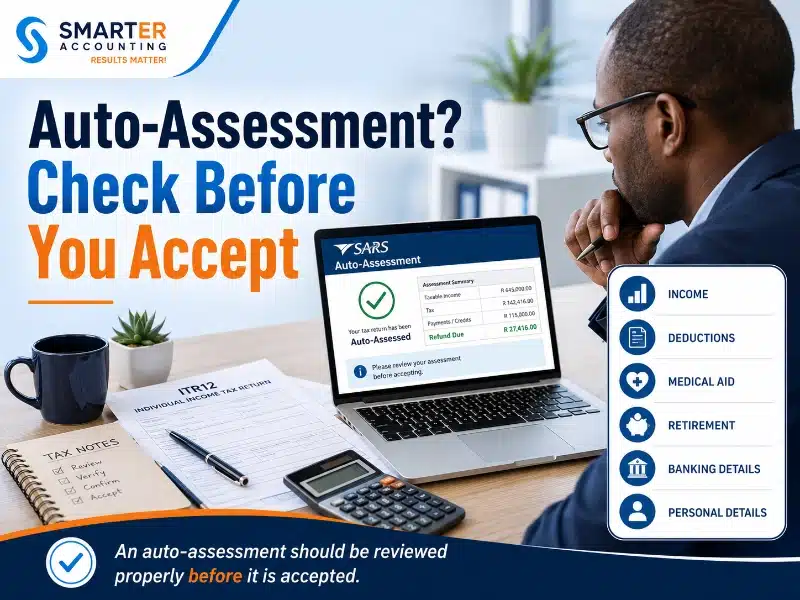
Before accepting an auto-assessment, check:
- income information;
- IRP5 details;
- medical aid information;
- retirement fund contributions;
- investment income;
- deductions and rebates;
- banking details;
- personal details;
- whether anything important is missing.
This is especially important if you have:
- more than one income source;
- investment income;
- rental income;
- retirement annuity contributions;
- medical expenses;
- travel claims;
- business or freelance income;
- deductions that may not be reflected automatically.
If the auto-assessment is wrong and you accept it, correcting the position later can take time.
In plain English: do not click “accept” just because SARS made the button look friendly.
Check first.
3. Gather Your Supporting Documents Early
Tax season becomes painful when documents are missing.
By the time SARS asks for supporting documents, you do not want to be searching through email folders, WhatsApp messages, old files, drawers, shoeboxes and “I’m sure I had it somewhere” chaos.
That is not a filing system.
That is a treasure hunt with penalties.
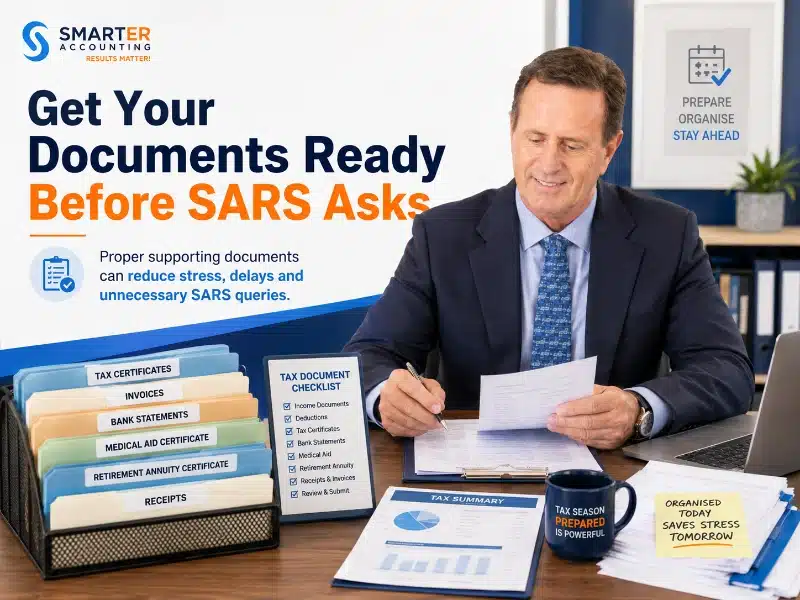
Start gathering the following:
- IRP5 / IT3(a) certificates;
- medical aid tax certificates;
- retirement annuity certificates;
- investment income certificates;
- bank statements;
- business income records;
- supplier invoices;
- deductible expense records;
- receipts and proof of payment;
- rental income and expense records, where applicable;
- logbooks, where applicable;
- donation certificates, where applicable;
- loan and finance statements;
- asset purchase invoices;
- SARS correspondence.
For business owners, the document trail matters even more.
If you want to claim an expense, reduce taxable income, support VAT claims or explain your numbers, you need records.
A deduction without supporting documents can quickly become a problem if SARS asks questions.
And SARS does ask questions. Usually with the charm of a frozen brick.
4. Business Owners Must Check Their Books Before Filing
For business owners, tax season is not only about submitting an individual tax return.
It is also a test of whether the business records are clean, complete and reliable.
If your bookkeeping is behind, your tax position is already on shaky ground.
Tax planning only works when the accounting records are correct. Otherwise, you are not planning — you are guessing with a spreadsheet.
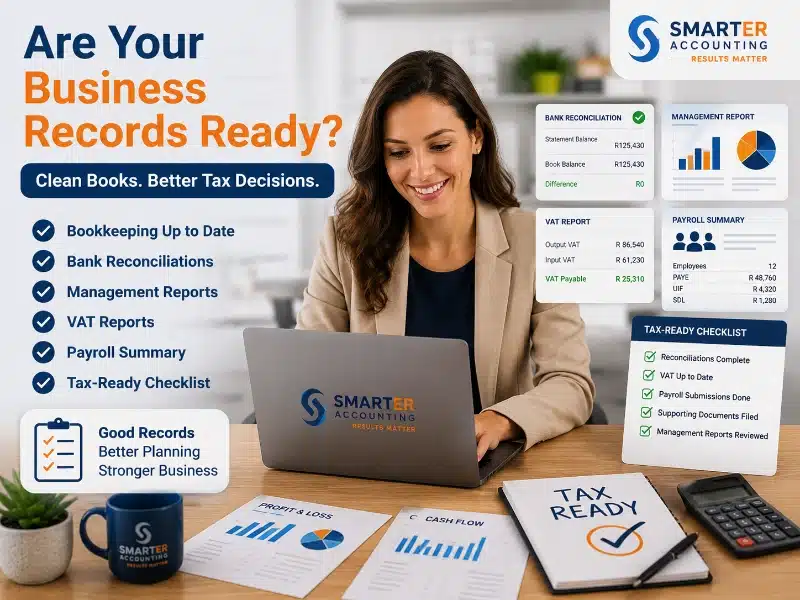
Before filing, business owners should check whether:
- bookkeeping is up to date;
- bank accounts are reconciled;
- income has been captured correctly;
- supplier invoices and expenses have been recorded;
- VAT transactions are correctly allocated;
- payroll records are complete;
- loan accounts and drawings are properly recorded;
- debtors and creditors are reasonable;
- stock and assets have been reviewed;
- depreciation and asset write-offs have been considered;
- management reports make sense.
If the books are wrong, the tax return will probably be wrong too.
That is the blunt truth.
A neat tax return built on messy books is still a messy tax return. It just wears a tie.
5. Review Deductions, VAT, Payroll and Provisional Tax
This is where many business owners either lose money or create risk.
Some underclaim valid expenses and pay more tax than necessary.
Others overclaim, mix personal expenses into the business, or submit VAT and payroll figures that do not tie back to the accounting records.
Neither approach is good.
The target is not aggression.
The target is accuracy.

Before filing, review:
- business expenses;
- accounting fees;
- software costs;
- insurance;
- bank charges;
- internet and telephone costs;
- repairs and maintenance;
- travel and motor vehicle costs, where properly supported;
- home office costs, where properly applicable;
- bad debts, where applicable;
- asset write-offs and depreciation;
- VAT input claims;
- PAYE, UIF and SDL records;
- EMP201 and EMP501 submissions;
- provisional tax estimates;
- projected cash flow for tax payments.
VAT, payroll and provisional tax are not side issues.
They are part of the bigger compliance picture.
If the VAT return does not agree with the accounting records, there may be a problem.
If payroll does not agree with SARS submissions, there may be a problem.
If provisional tax was not planned properly, there may be a cash-flow problem waiting around the corner.
Do not wait until the deadline to discover that the numbers do not tie up.
Final Thought
Tax season has started, but that does not mean you need to panic.
It means you need to prepare.
Check your dates. Review your auto-assessment. Gather your documents. Clean up your bookkeeping. Review your deductions. Check VAT and payroll. Plan provisional tax before it becomes a cash-flow problem.
A few hours of preparation now can prevent days of stress later.
Because when SARS starts asking questions, “I was busy” is not a tax strategy.
Free Tax Season Readiness Review
Before tax season gets into full swing, Smarter Accounting is offering a free initial consultation to help business owners and taxpayers identify what needs attention.
We can help you review:
- whether your tax documents are ready;
- whether your bookkeeping is up to date;
- whether your auto-assessment should be checked before acceptance;
- whether your business expenses and deductions need review;
- whether your VAT and payroll records are complete;
- whether your provisional tax planning is on track;
- whether your business is tax-season ready.
No pressure.
No jargon avalanche.
Just practical advice to help you prepare properly.
Need Help Getting Tax Season Ready?
If you are not sure whether your records, tax position, deductions, bookkeeping, VAT, payroll or provisional tax planning are ready, let’s take a proper look.
David Hartley
Smarter Accounting
Where Results Matter
WhatsApp / Mobile: 082 061 2300
Email: david@smarteraccounting.co.za
Website: www.smarteraccounting.co.za
Book your free consultation and make sure your tax season starts with clarity — not chaos.