
Tax Season 2026 Is Officially Here: What Business Owners and Taxpayers Should Do Now
Tax season has officially arrived on the radar.
SARS has confirmed the 2026 tax filing season dates, and that means business owners, provisional taxpayers, individuals and anyone with more complex tax affairs should start preparing now — not when the deadline is already breathing down their neck.
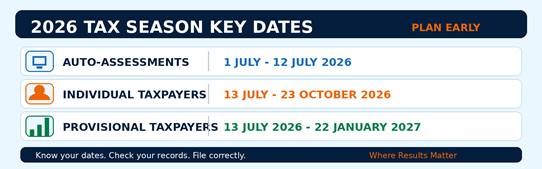
SARS has also encouraged taxpayers to make sure their personal details and banking details are updated online before filing season starts.
That may sound simple, but tax season is where many problems surface.
Missing documents. Incorrect auto-assessments. Old banking details. Unclaimed deductions. Incomplete bookkeeping. VAT and payroll records that do not tie up. Business owners who only realise too late that provisional tax should have been planned months ago.
The good news is that most tax-season stress can be reduced with early preparation.
Here is what you should do now.
1. Do Not Accept an Auto-Assessment Without Checking It
Auto-assessments can be useful, but they are not magic.
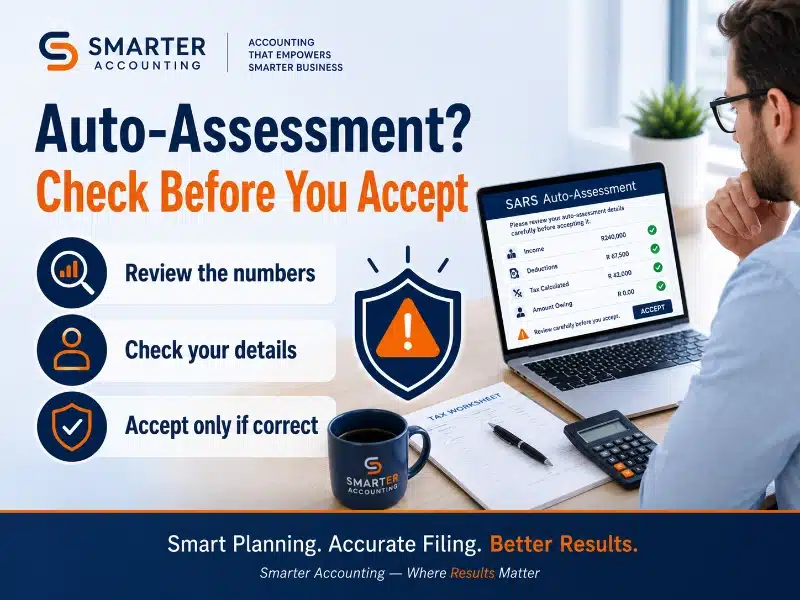
SARS uses information available from third parties, such as employers, medical schemes, financial institutions and retirement funds. That can save time, but it does not mean the assessment is automatically complete or correct.
Before accepting an auto-assessment, taxpayers should check:
- income information
- IRP5 details
- medical aid information
- retirement fund contributions
- investment income
- deductions and rebates
- banking details
- personal details
- whether anything important is missing
SARS specifically advises taxpayers who receive an auto-assessment to review it carefully, check that information is correct, and only accept the outcome if everything is accurate.
This is important because once an auto-assessment is accepted, fixing mistakes later can become more time-consuming.
In plain English: do not click “accept” just because the button looks friendly.
2. Gather Your Supporting Documents Early
Tax season becomes painful when taxpayers wait until the last minute to find documents.
By then, bank statements are missing, tax certificates are hiding, medical aid information has not been checked, and business expenses are scattered across email inboxes, shoeboxes and “I’ll find it later” folders.

Start gathering documents now, including:
- IRP5 / IT3(a) certificates
- medical aid tax certificates
- retirement annuity certificates
- investment income certificates
- rental income and expense records
- logbooks, where applicable
- donation certificates, where applicable
- business income records
- deductible expense records
- bank statements
- supporting invoices and receipts
For business owners, the list is even more important because business records need to support what is claimed.
A deduction without proper support can become a problem if SARS asks questions.
And SARS does ask questions. Sometimes with the warmth of a frozen brick.
3. Business Owners Must Check Their Bookkeeping Before Filing
For business owners, tax season is not just about filing an individual return.
It is also a test of whether the business records are clean, complete and reliable.
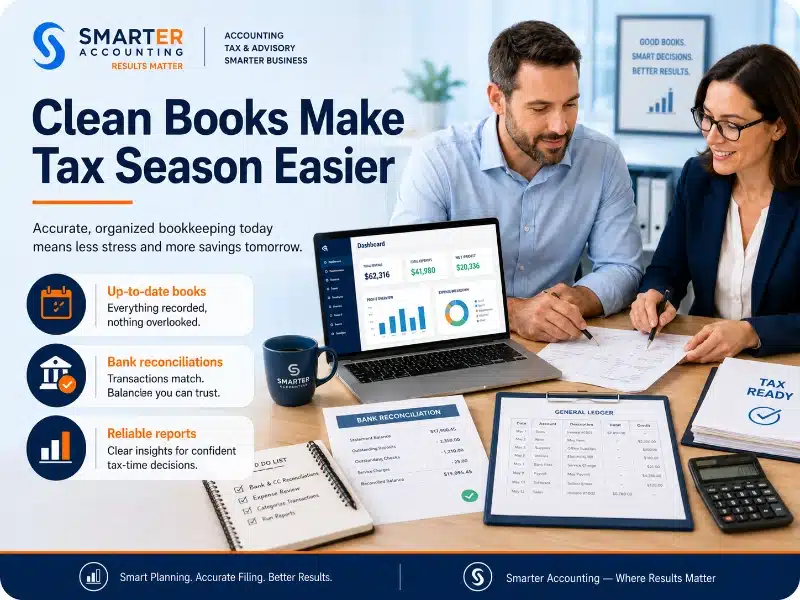
Before tax season, business owners should check whether:
- bookkeeping is up to date
- bank accounts are reconciled
- income has been captured correctly
- business expenses are properly allocated
- VAT records are complete
- payroll records are accurate
- loan accounts and drawings are correctly recorded
- debtors and creditors are reasonable
- assets and depreciation have been reviewed
- provisional tax estimates make sense
If the books are wrong, the tax return will probably be wrong too.
That is the blunt truth.
Tax planning only works when the accounting records are reliable. Otherwise, you are not planning — you are guessing with a spreadsheet.
4. Review Deductions Before You File
Many taxpayers and business owners either underclaim or overclaim.
Both are a problem. Underclaiming means you may pay more tax than necessary. Overclaiming means you may create risk if SARS reviews the return.

Before filing, review whether all valid deductions and tax items have been considered, such as:
- business expenses
- accounting fees
- software costs
- home office expenses, where properly applicable
- retirement contributions
- medical aid credits
- donations to approved public benefit organisations
- travel claims, where properly supported
- bad debts, where applicable
- asset write-offs and depreciation
- VAT input claims for VAT-registered businesses
The goal is not to be aggressive.
The goal is to be accurate, complete and properly supported.
Good tax planning is not about being clever after the deadline. It is about keeping proper records before the deadline.
5. Provisional Taxpayers Should Not Wait Until January
Provisional taxpayers have a longer filing window, but that does not mean they should relax and wake up in January.
SARS confirms that provisional taxpayers have from 13 July 2026 to 22 January 2027 to file.
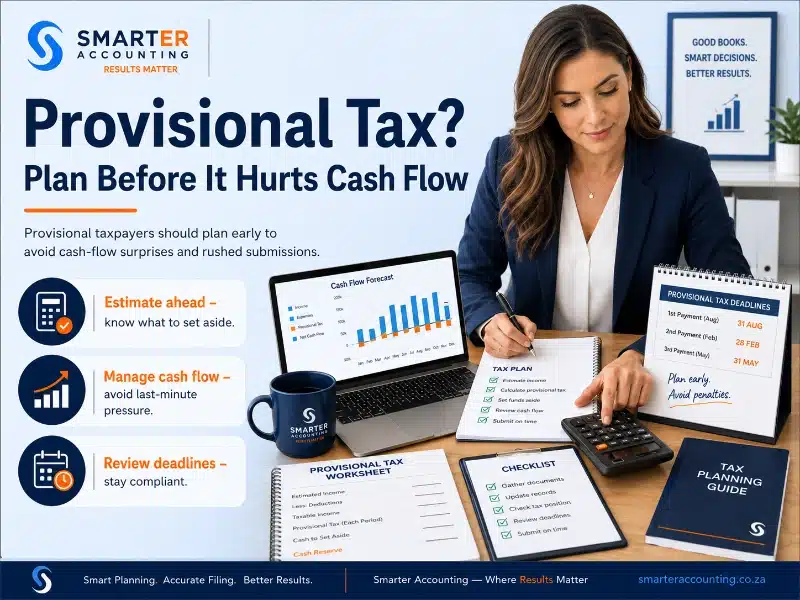
That may sound far away, but provisional taxpayers often have more complex affairs, such as:
- business income
- freelance income
- rental income
- investment income
- multiple income streams
- capital gains
- expenses requiring proper records
Provisional tax is not a separate tax. SARS describes it as a method of paying income tax in advance during the year, based on estimated taxable income, so taxpayers do not face one large tax debt on assessment.
That means business owners and provisional taxpayers should review their numbers early, not after the cash has already been spent.
The real danger is not only the filing deadline.
The real danger is poor planning.
Final Thought
Tax season does not have to be a panic event.
But it becomes one when taxpayers leave everything until the last minute.
The best time to prepare is now. Check your dates. Review your documents. Update your details. Check your auto-assessment before accepting it. Make sure your bookkeeping is clean. Review your deductions. Plan your provisional tax properly.
A little preparation now can prevent a lot of stress later.
Because when SARS starts asking questions, “I was busy” is not a tax strategy.
Free Tax Season Readiness Review
Before tax season gets into full swing, Smarter Accounting is offering a free initial consultation to help you identify what needs attention.
We can help you review:
- whether your tax documents are ready
- whether your bookkeeping is up to date
- whether your business expenses and deductions need review
- whether your VAT and payroll records are complete
- whether your auto-assessment should be checked before acceptance
- whether your provisional tax planning is on track
- whether your business is tax-season ready
No pressure.
No jargon avalanche.
Just practical advice to help you prepare properly.
Need Help Getting Tax Season Ready?
If you are not sure whether your records, tax position, deductions, bookkeeping, VAT or provisional tax planning are ready, let’s take a proper look.
David Hartley
Smarter Accounting
Where Results Matter
WhatsApp / Mobile: 082 061 2300
Email: david@smarteraccounting.co.za
Website: www.smarteraccounting.co.za
Book your free consultation and make sure your tax season starts with clarity — not chaos.