
Before Tax Season Starts: 7 Checks Every Business Owner Should Do Right Now
Tax season does not become stressful because SARS suddenly appears.
It becomes stressful because the records, documents, calculations and planning were not sorted out early enough.
With the 2026 filing season now around the corner, business owners should not wait until the last week before checking whether everything is ready. By then, missing invoices, incomplete bookkeeping, VAT questions, payroll issues and provisional tax problems have a nasty habit of arriving together like uninvited relatives.
The good news is simple: if you do the right checks now, tax season becomes far more manageable.
Here are seven checks every business owner should do before tax season starts:
- Check your bookkeeping is up to date.
- Gather your supporting documents.
- Review your business expenses and deductions.
- Check VAT, PAYE and payroll records.
- Review debtors, creditors, stock and assets.
- Check your auto-assessment and SARS details.
- Plan provisional tax and cash flow before it hurts.
The goal is not to panic.
The goal is to prepare.

1. Check That Your Bookkeeping Is Up to Date
Before tax season starts, the first question is not “How much tax must I pay?”
The first question is:
Are the books actually correct?
If your bookkeeping is months behind, your tax return is already starting on shaky ground. Tax planning only works when the accounting records are reliable. Otherwise, you are not planning — you are guessing with better stationery.

Before tax season, business owners should check whether:
- bank accounts are reconciled;
- all sales and income have been captured;
- all supplier invoices and expenses have been recorded;
- loan accounts and drawings are correctly allocated;
- VAT transactions have been posted correctly;
- payroll journals have been captured;
- debtors and creditors look reasonable;
- business assets are recorded properly;
- management reports make sense.
If the books are incomplete, the tax return will probably be incomplete too.
That is the blunt truth.
The tax return is only as reliable as the accounting records behind it. If the bookkeeping is messy, the tax result may also be messy — and SARS is not known for appreciating creative uncertainty.
2. Gather Your Supporting Documents Before SARS Asks
Tax season becomes painful when documents are missing.
By the time SARS asks for supporting documents, you do not want to be searching through emails, WhatsApp messages, shoeboxes, glove compartments, old files and “I’m sure I saved it somewhere” folders.
That is not a document system. That is a treasure hunt with penalties.

Start gathering the following documents now:
- IRP5 / IT3(a) certificates;
- medical aid tax certificates;
- retirement annuity certificates;
- investment income certificates;
- bank statements;
- business income records;
- supplier invoices;
- receipts for business expenses;
- rental income and expense records, where applicable;
- logbooks, where applicable;
- donation certificates, where applicable;
- loan statements and finance agreements;
- asset purchase invoices;
- supporting schedules for business deductions.
For business owners, the rule is simple:
If you want to claim it, you must be able to support it.
A deduction without proper support can quickly become a problem if SARS raises a query. It is far better to prepare the documents now than to scramble later.
3. Review Your Business Expenses and Deductions
Many businesses pay more tax than necessary because valid expenses are not captured properly.
Others create risk because expenses are claimed without proper support, or because personal expenses are mixed into the business accounts.
Both sides are a problem.
You do not want to underclaim legitimate expenses. You also do not want to overclaim and invite SARS to unpack your records like a detective with a calculator.

Before filing, review whether all valid business expenses have been captured, including:
- accounting fees;
- software subscriptions;
- bank charges;
- insurance;
- internet and telephone costs;
- office expenses;
- repairs and maintenance;
- marketing and advertising;
- professional fees;
- motor vehicle and travel costs, where properly supported;
- home office costs, where properly applicable;
- asset write-offs and depreciation;
- bad debts, where applicable.
The key phrase is properly supported.
If an expense is genuinely incurred in producing business income, it should be reviewed and recorded correctly. But personal spending should not be pushed into the business just because it makes the profit look smaller.
That is not tax planning.
That is tax trouble wearing a fake moustache.
4. Check VAT, PAYE and Payroll Records
Tax season is not only about income tax.
For many business owners, SARS also looks at the broader compliance picture: VAT, PAYE, UIF, payroll, EMP201s, EMP501s, IRP5s and related submissions.
If these records do not tie up, the tax return may not be the only problem.
Payroll and VAT mistakes can sit quietly in the background until tax season forces everything into the light.
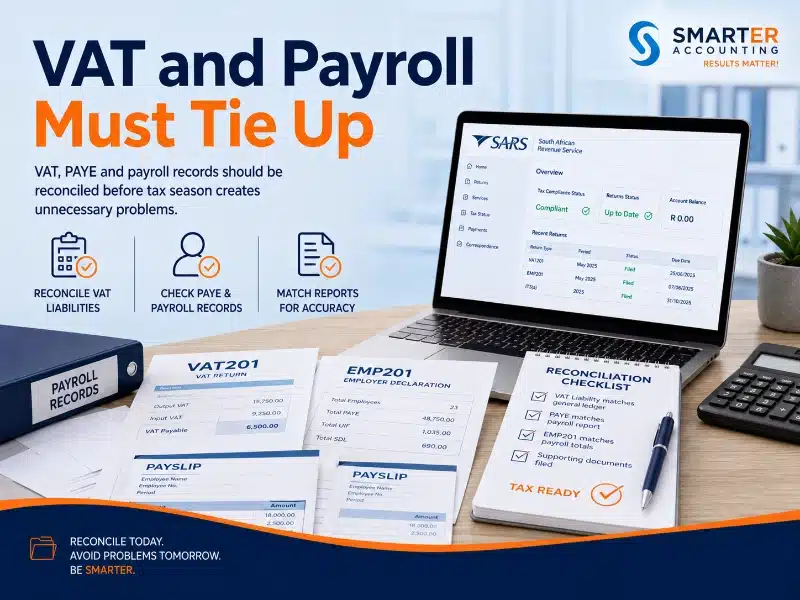
Before tax season, check whether:
- VAT returns agree to your accounting records;
- input VAT claims are supported by proper tax invoices;
- output VAT has been correctly declared;
- PAYE, UIF and SDL records are complete;
- EMP201 submissions agree to payroll records;
- EMP501 reconciliations have been completed correctly;
- IRP5 information is accurate;
- staff benefits and allowances have been treated correctly;
- payroll journals have been posted to the accounting system.
This is especially important where a business owner draws a salary, employs staff, claims input VAT, or has payroll-linked SARS submissions.
If VAT and payroll are not properly reconciled, the business may look compliant on the surface while quietly carrying risk underneath.
That is not where you want to be when SARS starts asking questions.
5. Review Debtors, Creditors, Stock and Assets
Tax season is also a good time to check whether the balance sheet reflects reality.
This is where many small businesses go wrong.
Old debtors remain on the books even though they may never pay. Creditors are outdated. Stock values are not reviewed. Assets are missing, duplicated or not depreciated correctly.
The result is financial statements that look neat, but do not reflect the real business position.
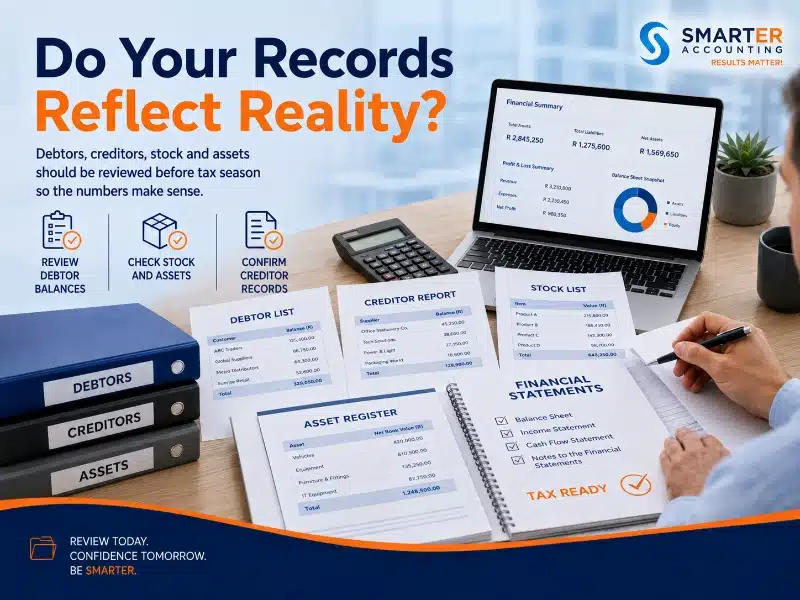
Before filing, review:
- old debtors that may not be recoverable;
- bad debts that may need to be written off;
- creditors that may be duplicated, outdated or incorrect;
- stock that is damaged, obsolete or no longer saleable;
- asset purchases during the year;
- asset disposals;
- depreciation and wear-and-tear calculations;
- finance agreements and loan balances;
- shareholder loan accounts and owner drawings.
This matters because tax is not only calculated from one number on a page.
The quality of the full accounting record matters.
If debtors, stock, assets and loans are wrong, the profit and tax position may also be wrong.
A clean review now can prevent awkward corrections later.
6. Check Your SARS Details and Auto-Assessment Position
Auto-assessments can be useful, but they must not be accepted blindly.
SARS may already have information from employers, medical schemes, banks, retirement funds and other third parties. That can make the process faster, but it does not guarantee that everything is complete or correct.
Business owners and taxpayers should treat an auto-assessment as something to review — not something to accept because the button is conveniently sitting there.
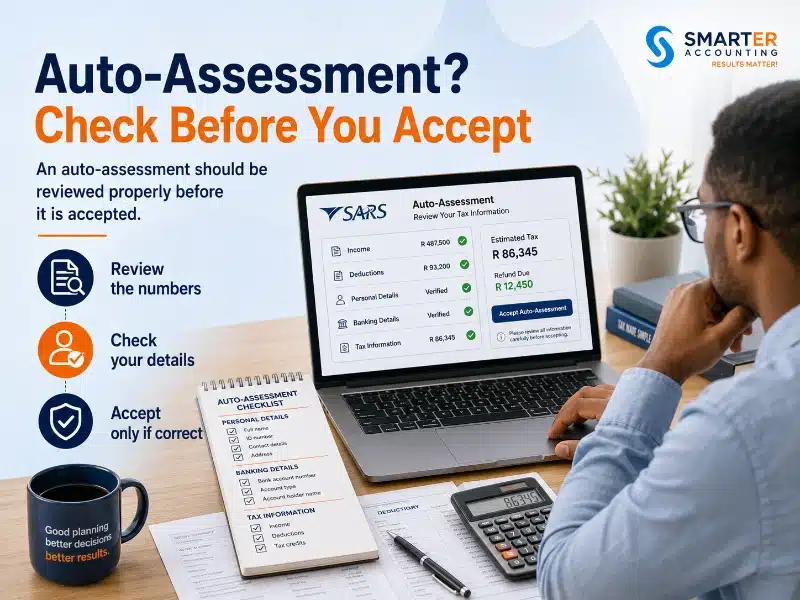
Before accepting anything from SARS, check:
- personal details;
- banking details;
- income information;
- IRP5 details;
- medical aid information;
- retirement fund contributions;
- investment income;
- deductions and rebates;
- whether any income or deductions are missing;
- whether the result looks reasonable.
Also make sure your SARS eFiling profile, contact details and banking details are updated before filing season starts.
This is basic, but important.
Old banking details or incorrect personal information can delay refunds, create administrative problems, or cause unnecessary back-and-forth.
In plain English: do not click “accept” just because SARS made it look easy.
7. Plan Provisional Tax and Cash Flow Early
Provisional taxpayers should not wait until the deadline before thinking about tax.
By then, the money may already have been spent.
For business owners, provisional tax is not just a compliance issue. It is a cash-flow issue. If the business does not plan ahead, tax becomes a sudden shock instead of a managed cost.

Business owners should review:
- expected taxable income;
- year-to-date profit;
- projected income to year-end;
- estimated tax liability;
- cash available for tax payments;
- owner drawings and salary;
- company tax obligations;
- provisional tax estimates;
- whether enough has been set aside.
Provisional tax is not a separate tax. It is a method of paying income tax during the year based on estimated taxable income.
That means estimates matter.
If the estimate is too low, there may be penalties and cash-flow pain later. If no planning has been done, the business owner may only realise the problem once the deadline is close.
That is not a strategy.
That is financial hide-and-seek.
Final Thought
Tax season does not have to be a panic event.
But it becomes one when business owners leave everything until the last minute.
The best time to prepare is now. Check your bookkeeping. Gather your documents. Review your expenses. Reconcile VAT and payroll. Check your balance sheet. Review auto-assessments properly. Plan provisional tax before it becomes a cash-flow problem.
A few hours of preparation now can prevent days of stress later.
Because when SARS starts asking questions, “I was busy” is not a tax strategy.
Free Tax Season Readiness Review
Before tax season starts properly, Smarter Accounting is offering a free initial consultation to help business owners identify what needs attention.
We can help you review:
- whether your bookkeeping is up to date;
- whether your tax documents are ready;
- whether your business expenses and deductions need review;
- whether your VAT and payroll records are complete;
- whether your debtors, creditors, stock and assets need checking;
- whether your auto-assessment or SARS details should be reviewed;
- whether your provisional tax planning is on track;
- whether your business is genuinely tax-season ready.
No pressure.
No jargon avalanche.
Just practical advice to help you prepare properly.
Need Help Getting Tax Season Ready?
If you are not sure whether your records, tax position, deductions, bookkeeping, VAT, payroll or provisional tax planning are ready, let’s take a proper look.
David Hartley
Smarter Accounting
Where Results Matter
WhatsApp / Mobile: 082 061 2300
Email: david@smarteraccounting.co.za
Website: www.smarteraccounting.co.za
Book your free consultation and make sure your tax season starts with clarity — not chaos.